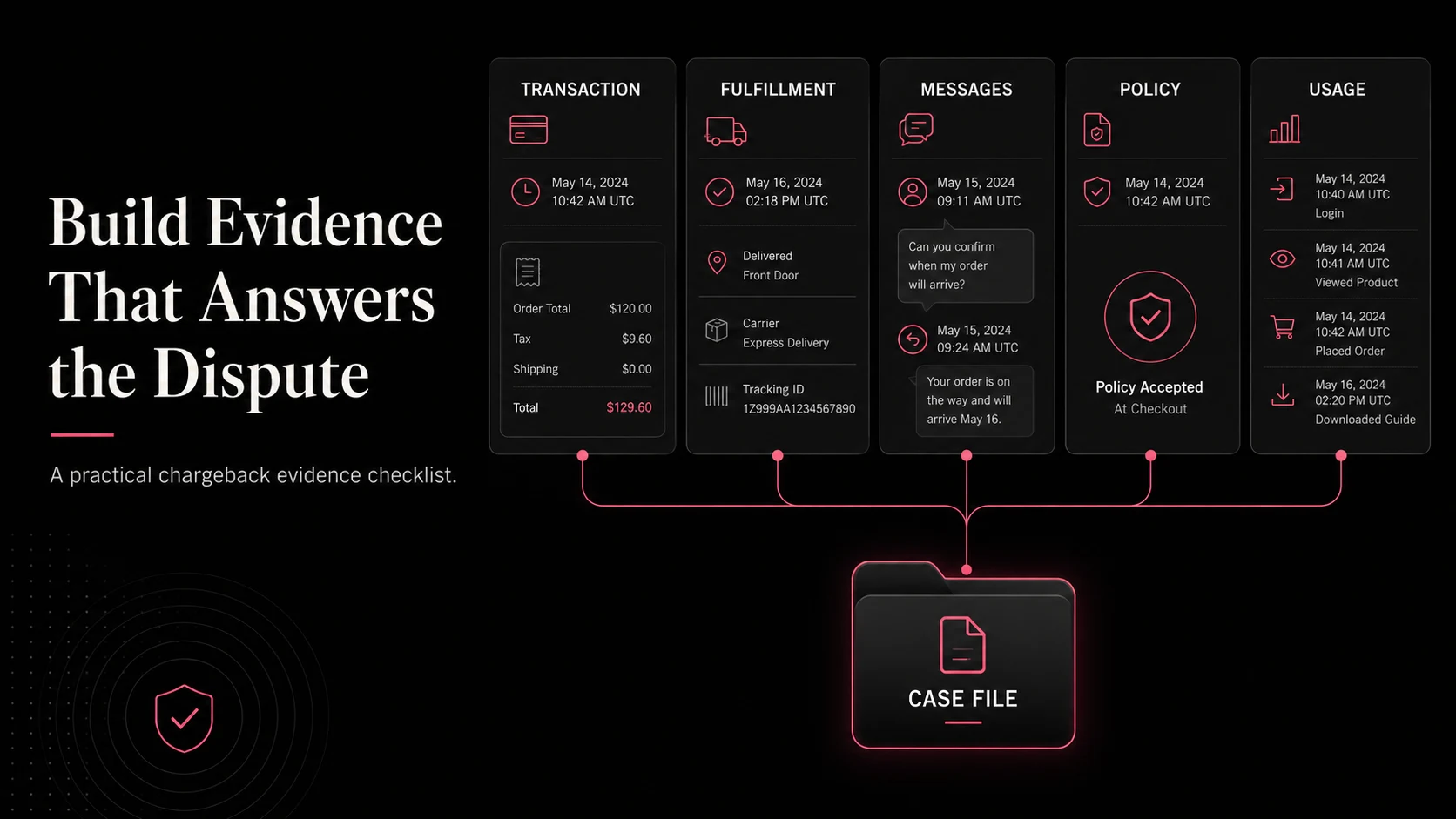
A useful chargeback evidence checklist is not a universal packet that you upload unchanged for every dispute. It is an inventory of records you can draw from after you know the reason for the dispute. The best evidence package is usually smaller than the full archive because each attachment has a job.
Keep original records where possible. Screenshots can be helpful for presentation, but exports, timestamps, transaction IDs, carrier events, support transcripts, and system logs often provide stronger context because they can be tied directly to the disputed order.
Transaction identity
Confirm the merchant order ID, processor transaction ID, amount, currency, transaction date, cardholder-facing descriptor, billing information, shipping information, and authorization signals available in your processor. These details establish exactly which purchase the packet concerns.
If the order includes multiple captures, partial refunds, or separate shipments, explain that structure early so the reviewer does not mistake a legitimate split transaction for duplication.
Fulfillment and delivery records
For physical goods, preserve the fulfillment timestamp, carrier, tracking number, delivery scans, delivery address, signature information when available, and any delivery-photo or pickup confirmation. If a package was rerouted or held, include the carrier history that explains the final delivery event.
A simple “delivered” screenshot may not be enough when the dispute alleges the item went to the wrong place. Match the delivery record to the address connected with the order and explain any customer-requested address change.
Customer communication
Save pre-sale questions, order confirmation messages, shipping notices, support tickets, cancellation requests, replacement offers, refund discussions, and any message where the customer acknowledges receipt or use. Keep the full conversation around a key statement rather than cropping away context.
If your team promised a refund and later missed it, that record matters too. Evidence collection should be factual even when the facts weaken the case.
Policies and consent
Keep the version of your return, cancellation, trial, subscription, and delivery policies that applied at checkout. A current policy page is not necessarily proof of what the customer saw months earlier. Versioning or dated exports make policy evidence more credible.
Where your checkout records consent to terms, preserve the timestamp and the mechanism of acceptance. A policy can support a case, but it should not be treated as a substitute for showing what actually happened.
Usage and access for digital products
Digital products need a different evidence stack: account creation, login timestamps, IP or device information where lawfully collected, download events, lesson completion, API calls, seat invitations, support interactions, and cancellation history. Focus on records that show the customer received or used the purchased access.
Do not over-collect personal data merely for future chargebacks. Retention should match legitimate business needs and your published privacy practices.
How to turn a large evidence archive into a small case file
A merchant may have fifty possible records for one order: payment logs, fraud scores, two carrier pages, six emails, return terms, product screenshots, warehouse notes, and account history. The checklist should not cause all fifty to be uploaded. Start with the allegation and assign each proposed record a job: transaction identity, fulfillment, consent, customer acknowledgement, or financial correction.
If two exhibits prove the same fact, keep the clearer one and retain the other internally. If a record proves nothing material, omit it. This discipline is especially important in digital-goods cases where teams can overwhelm a reviewer with IP addresses, login events, and device data even though the real dispute is simply whether cancellation happened before renewal.
Before submission, have a second person verify that every exhibit can be tied to the challenged transaction and that no attachment contains an unrelated customer's data. Evidence quality includes relevance and privacy, not just completeness.
How to grade evidence instead of treating every document equally
An evidence checklist becomes more useful when the merchant ranks records by what they actually prove. Start with direct transaction records: processor identifiers, authorization or capture data, order details, delivery events, cancellation timestamps, refund confirmations, and customer messages tied to the disputed purchase. These records establish the commercial event itself. Then add corroborating material such as account history, prior undisputed orders, device signals, or policy acceptance. Corroboration can strengthen a coherent story, but it should not be used to fill a gap in the core event. For example, a familiar device does not replace proof that a service was actually delivered when the dispute is non-receipt.
A second grade is source quality. Prefer records exported from the system that created the event over screenshots copied from a dashboard when both are available. A carrier's detailed tracking history is generally more informative than a merchant admin badge that simply says 'delivered.' A payment-provider refund record with amount and date is stronger than a support note saying 'refund sent.' When only a screenshot exists, capture enough surrounding context to show what system, order, date, and status the screenshot refers to. Cropped fragments may look neat but can make verification harder.
Third, test whether each exhibit answers the specific dispute. If the allegation is cancellation before renewal, shipping records are irrelevant. If the allegation is duplicate processing, a return policy does not explain why two charges exist. If the dispute is not-as-described, authorization data may establish that the card was used but says little about the promised product. This allegation-to-exhibit test is the quickest way to shrink a bloated file. Put every proposed exhibit into one of three buckets: necessary, corroborative, or unrelated. Remove the unrelated bucket before submission.
Finally, review privacy and readability. A packet can be factually strong and still be poorly prepared if it exposes another customer's information, contains unreadable screenshots, or forces the reviewer to hunt through dozens of pages. Redact unrelated personal information where appropriate, label exhibits consistently, and create a short index for larger cases. The objective is not maximum volume. It is a verifiable chain from disputed transaction to relevant fact, with enough context that a reviewer can understand what happened without guessing.
A final evidence-gap check before submission
Before the packet leaves the merchant, ask one reviewer to mark every material sentence in the rebuttal with the exhibit that supports it. Any sentence without a source should be deleted, rewritten as an inference, or supported with a better record. Then run the opposite test: every exhibit should have a reason to be there. If a screenshot, log export, policy page, or email does not prove a disputed fact, remove it from the external packet and keep it only in the internal archive. This two-way test prevents both unsupported claims and evidence dumping.
Also check temporal accuracy. A current policy, product page, account status, or tracking page may not represent what existed when the transaction occurred. Prefer purchase-time records, dated exports, immutable transaction IDs, and versioned terms. If the merchant cannot prove the older state, say so internally rather than substituting a newer screen. A checklist is valuable only when it improves evidence quality, not when it turns every available record into an attachment.
VERIFY CURRENT RULES
Primary references
Processor interfaces, reason-code mappings, filing windows, and network rules can change. Check the active dispute notice and current official documentation before submitting.